13 legal obligations every Quebec condo syndicate must meet
A practical walkthrough of the 13 legal obligations — annual meeting, contingency fund, maintenance logbook, Bill 25, syndic certificate — that structure how a condo syndicate operates in Quebec. Cited, grouped by theme, written for board members.
If you sit on the board of a Quebec condo syndicate (syndicat de copropriété), you've probably noticed the rules don't all live in one place. The Civil Code of Quebec lays the foundation, but Bill 141 (2018), Bill 16 (2019), and Bill 25 (2024) reshuffled the deck — with different deadlines and very real penalties.
We counted thirteen distinct legal obligations that apply to virtually every syndicate, regardless of size. Some are well known. Others trip up brand-new boards every spring. This post walks through them, grouped by what they actually do for you — not by which law they're parked under.
Governance — keep the syndicate legally constituted#
1. Hold an annual general meeting within 90 days of fiscal year-end#
Article 1087 C.c.Q. requires the AGM within 90 days of the close of the fiscal year. Co-owners must receive notice at least 10 days in advance, with the agenda, the prior year's minutes, and the next year's draft budget.
2. Distribute meeting minutes within 30 days#
Minutes from any meeting — AGM or special — must reach co-owners within 30 days. It's one of the most-forgotten obligations, and the easiest to fix with a calendar reminder.
3. Maintain the syndicate's books and records#
Article 1070 C.c.Q. lists what has to be available for any co-owner to consult: declaration of co-ownership, by-laws, AGM minutes, financial statements, contingency-fund study, maintenance logbook, and the syndic certificate template. Incomplete records are the #1 source of disputes between co-owners and boards.
4. Keep your REQ registration current#
Every syndicate is a legal person registered with the Registre des entreprises du Québec. The annual update — NEQ, directors, address — is due on the date assigned to your syndicate. Missing it triggers a notice of cancellation and, eventually, dissolution.
Finances — fund the building, file the right returns#
5. Constitute and maintain a contingency fund#
Article 1071 C.c.Q. requires a minimum contribution of 5% of common expenses. The fund sits in a separate account and can only be used for major repairs and replacement of common portions.
6. Have a contingency-fund study performed every 5 years#
Bill 16 added article 1071.1: a certified professional (engineer, architect, or appraiser) studies the building's components, their remaining useful life, and projects future capital needs. The study sets the contributions for the next five years.
7. Hold a self-insurance fund equal to the highest deductible#
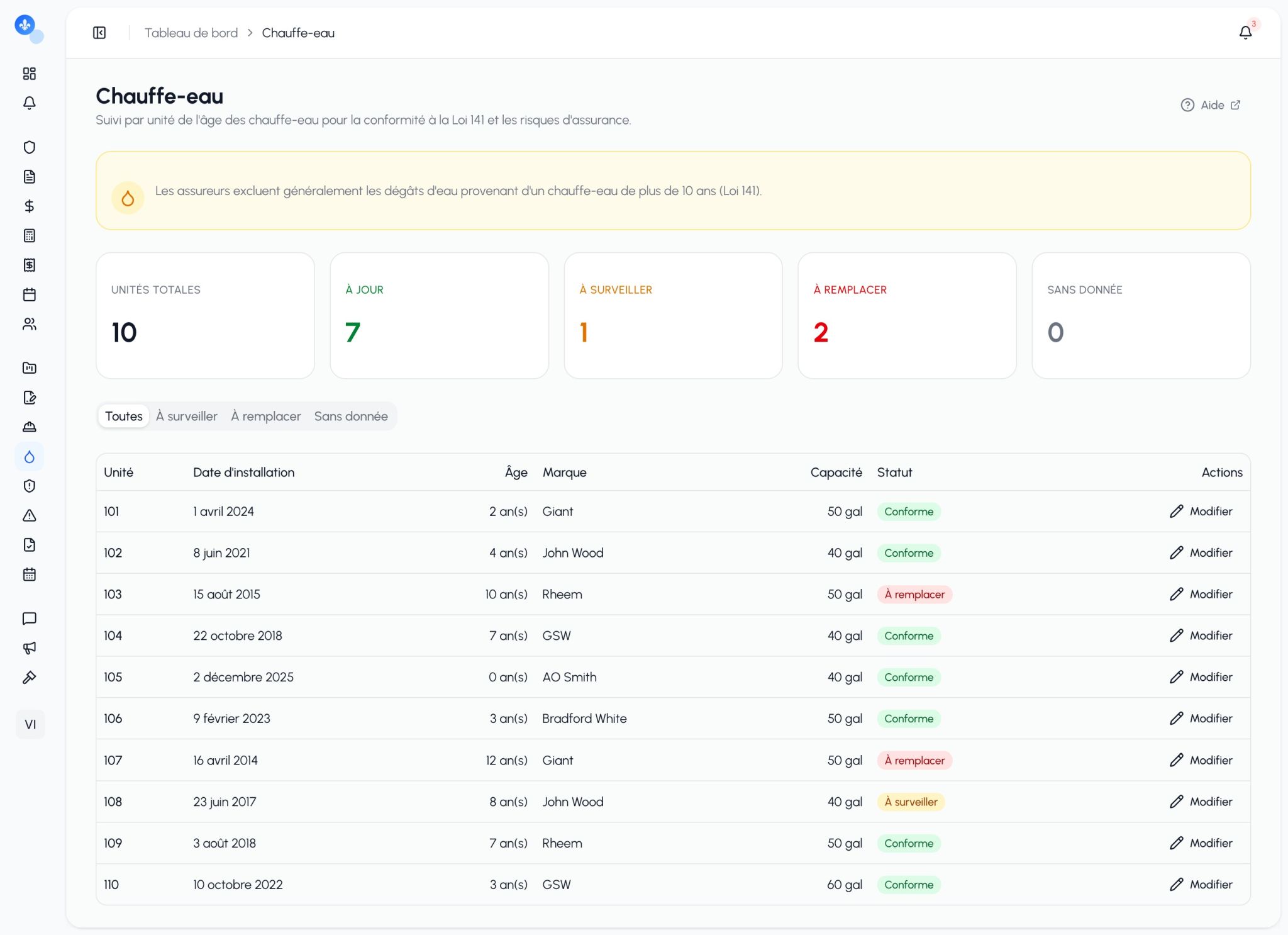
Bill 141 introduced this in article 1073: the syndicate must maintain a fund equal to the highest deductible on its insurance policy, to cover losses below the threshold. This fund is on top of the contingency fund — not part of it.
8. File annual corporate tax returns#
A Quebec syndicate is treated as a corporation for tax purposes — federal T2 and provincial CO-17 (or, for small syndicates with no business income, the simplified TP-985 trust return). A missed filing draws penalties even when the syndicate has no taxable income.
Building — track and insure what you own#
9. Keep a building maintenance logbook (mandatory by August 2028)#
Bill 16, article 1070.2: every syndicate must maintain a carnet d'entretien — a structured log of inspections, repairs, warranties, contractor info, and recommended maintenance schedules. The deadline for all existing syndicates to have one in place is August 2028 — sooner than it sounds, and one of the documents new buyers always ask for.
10. Re-evaluate the building's reconstruction value every 5 years#
Bill 141, article 1073: an OEAQ-certified appraiser (Ordre des évaluateurs agréés du Québec) must produce the reconstruction-value evaluation every five years. It feeds the master insurance policy's coverage amount and prevents the syndicate from being underinsured after a major loss.
11. Hold the mandatory insurance coverage#
Civil liability for the building plus reconstruction insurance against the usual perils. Both are required under article 1073 C.c.Q. and adjusted annually based on the latest reconstruction-value evaluation.
Compliance — privacy, transparency, communication#
12. Comply with Bill 25 (privacy)#
If your syndicate handles personal data — and every syndicate does, from co-owner contact lists to portal logins — Bill 25 has applied since September 2023. The board must designate a privacy officer (DPO), keep an incident registry, run a privacy-impact assessment for high-risk processing, and notify the Commission d'accès à l'information within 72 hours of any confidentiality incident.
13. Issue the syndic certificate within 15 days when requested#
Article 1068.2 C.c.Q.: when a co-owner sells their unit, the syndicate has 15 days to deliver a certificat de syndic — a document attesting to the buyer's future legal obligations, the state of finances, ongoing litigation, and assessment notices. Delay slows down the sale; refusal is a breach of duty.
The thread running through all 13: the documentation trail#
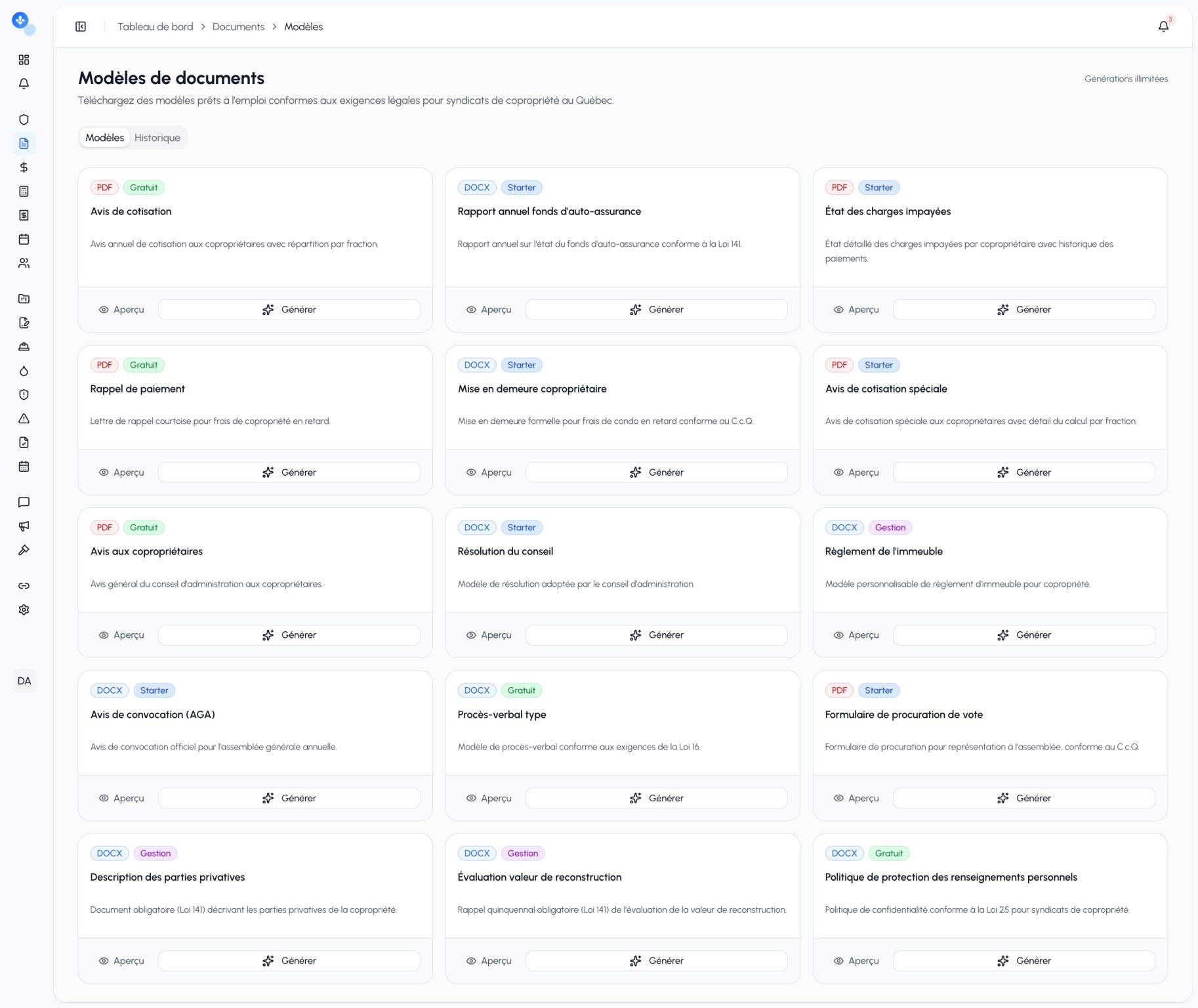
All thirteen obligations share one common mechanic — they generate documents the board has to keep, retrieve, and produce on demand. AGM minutes, contingency-fund study, maintenance logbook, certificate template, insurance policy, reconstruction evaluation, REQ confirmations, tax notices, Bill 25 incident registry, board resolutions.
A syndicate that keeps these in order rarely falls behind on any single obligation. A syndicate that doesn't usually finds out the hard way — at the next sale, the next AGM, or the next inspection.
Most syndicates manage these 13 obligations in their head or on a spreadsheet. A single missed deadline can be expensive — in penalties, in stalled sales, in litigation.
Syndic+ tracks all 13 obligations automatically and alerts you 30 days before each deadline. Every obligation on this list maps to a module: meetings, finances, maintenance logbook, certificates, compliance. 14-day free trial, no credit card.